The best tattoo voltage for lining and shading
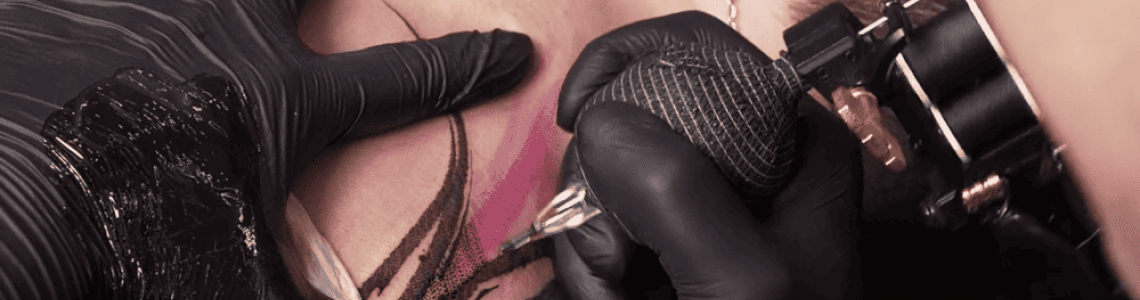
It's be real—voltage is one of those things that separates clean, crisp tattoos from messy blowouts and inconsistent lines. It's not glamorous to talk about, but it's absolutely crucial. Whether you're a newbie just picking up your first machine or a seasoned artist tweaking your setup, understanding the right voltage for different techniques can literally change your game.
Think of voltage like the gas pedal in your car. Too much, and you're flying erratically. Too little, and you're crawling. The sweet spot? That's where the magic happens. In this guide, we're breaking down the optimal voltage for lining and shading, so you know exactly where to dial in your machine for flawless results.
Want the full deep-dive? Check out our Ultimate Guide to Tattoo Voltage for comprehensive info on power supplies, technical specs, and advanced tuning.
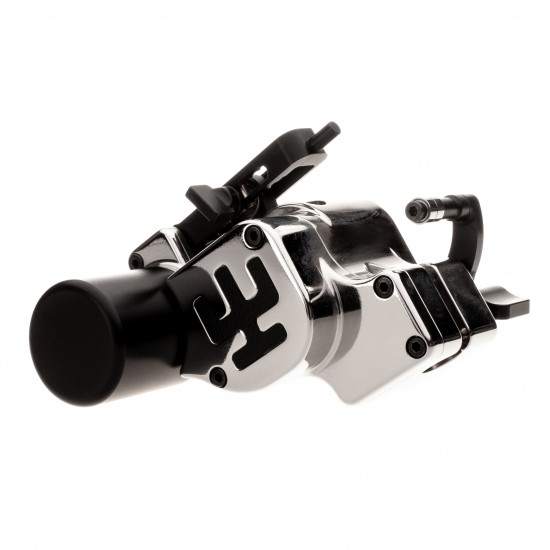 Avenger 3 Pro Nickel
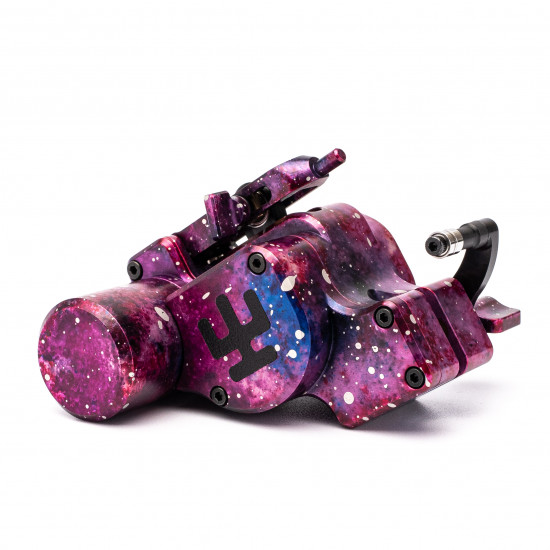 Avenger 3 Pro Space
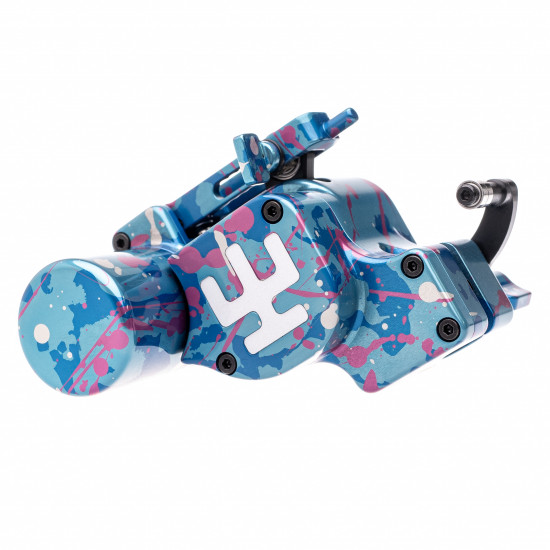 Avenger 3 Pro Sky Dream
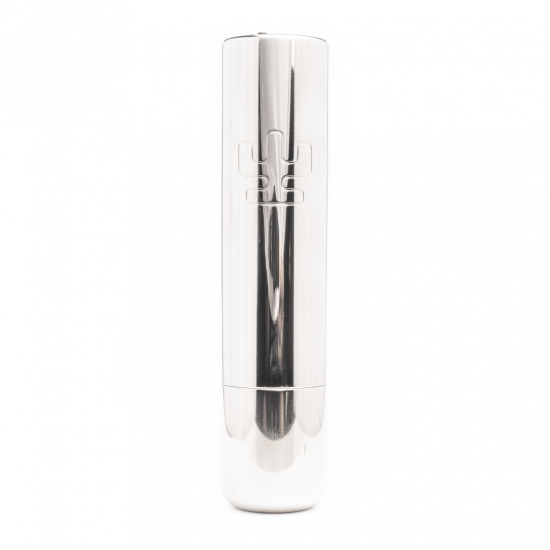 Ultron 3 Nickel
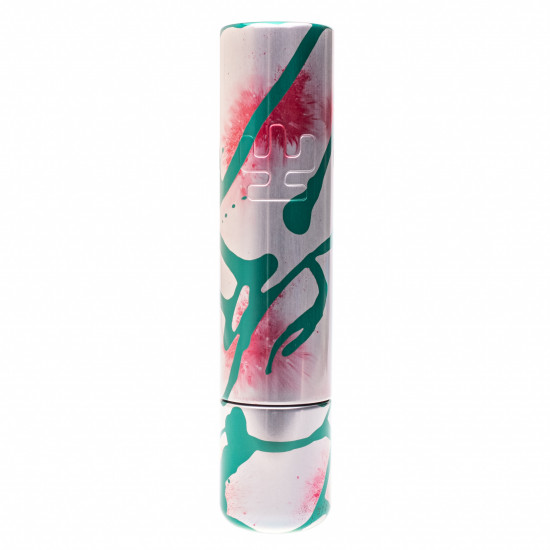 Ultron 3 Polar Day
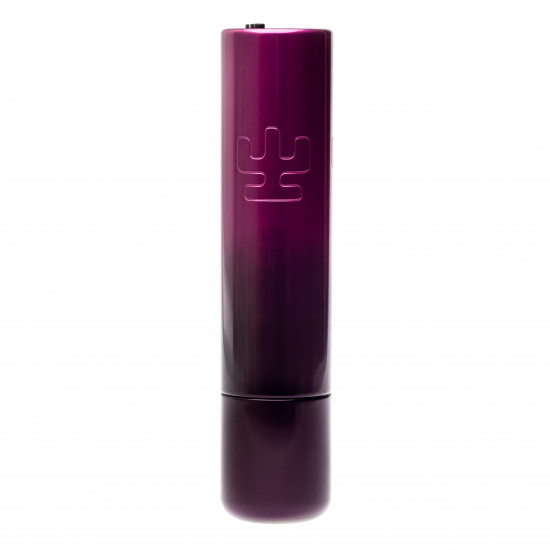 Ultron 3 Magic Magenta
Optimal voltage for lining: finding your sweet spot
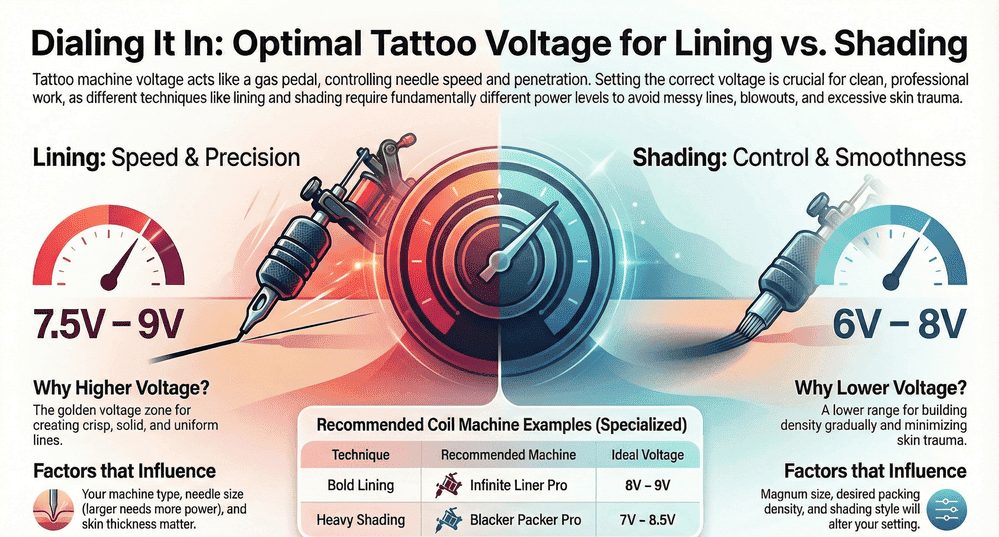
When it comes to lining, you're looking at a voltage range of 7.5V to 9V. This is your golden zone. But here's why these numbers matter, not just what they are.
Why 7.5-9V?
 Le
Le
Lining requires speed and precision. You need your needle to penetrate skin consistently and lay down a solid, uniform line without dragging or skipping. At 7.5-9V, your machine has enough juice to:
Punch through skin with authority (needle penetration).
Maintain line density across the entire stroke.
Give you control without going too aggressive.
Work with various needle sizes (3RL through 18RL).
The lower end of the range (7.5-8V) is perfect when you're working with finer needles (3-5RL) or doing detailed, precise line work. The upper end (8.5-9V) is ideal for bolder lines using larger needles (11-18RL) and solid coverage.
Factors that influence your ideal lining voltage
Machine type: coil machines, rotary machines, and hybrid machines all behave differently at the same voltage.
Needle size: larger needles need more voltage to perform properly.
Skin type: thicker skin (back, chest) might need slightly higher voltage; thin skin (ribs, neck) needs less.
Your technique: faster, lighter hand pressure might work better at lower voltage.
Machine quality: a well-engineered machine holds consistent voltage better than a poorly made one.
Pro tip for beginners: start at 7.5V and run a few practice lines on synthetic skin. Gradually bump it up 0.5V at a time until you find where your lines look cleanest and sharpest. Document that number—it's your baseline.
Optimal voltage for shading: control is everything
Shading is a totally different beast. Here, you're dialing in 6V to 8V. Notice it's lower than lining? That's intentional, and it matters way more than people realize.
Why 6-8V?
Shading is all about control and smoothness. You're not trying to punch a line—you're trying to build density gradually, create smooth transitions between tones, and minimize skin trauma. Lower voltage gives you:
Gentler penetration (less blowouts on edges).
Better feedback from the skin.
Smoother packing without overworking the area.
Faster healing with less inflammation.
More precise color placement with magnum needles.
The lower end (6-6.5V) is your go-to for soft shading, color packing on sensitive areas, and techniques that require a delicate touch. The upper end (7-8V) works for heavier shading, black packing, and areas where you need more density.
Key differences from lining
You're working with larger surface areas (magnums instead of rounds), so you need less aggressive needle speed. Too much voltage plus magnum needle equals overworked skin, unnecessary trauma, and potential scarring.
Factors that influence your ideal shading voltage:
Magnum size: 7M starts lower; 15M+ can handle 7-8V.
Packing density: solid black work needs higher voltage; soft shading needs lower.
Shading style: hard shading versus soft blending requires different approaches.
Client's skin: some skin takes color easier than others.
Healing goals: if you want faster healing, stay on the lower end.
Pro tip: if you're new to shading, start at 6V. You can always add more voltage, but you can't undo skin damage. Find your rhythm at lower voltage first, then adjust up if needed.
Top lining machines from Vlad Blad
1. Infinite Liner Pro
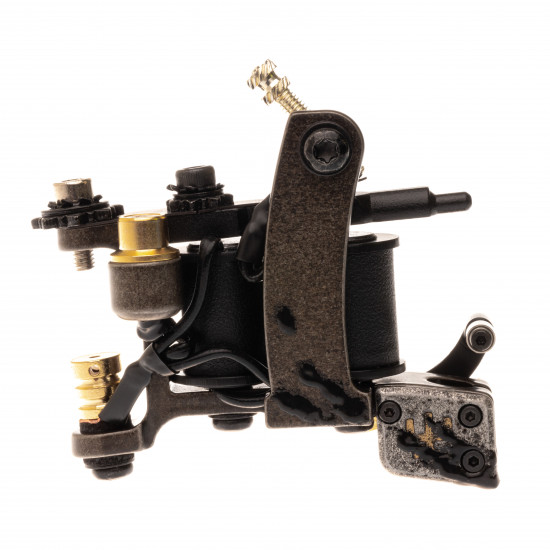
Type: coil | Weight: 212g | Voltage: 8–9V | Best For: bold, clean lines; solid coverage
Infinite Liner Pro is the heavyweight champion of line work. A pure coil machine with a heavy steel frame (212g), it delivers the kind of sharp, authoritative punch that makes bold lines sing. It's been around for 15+ years and you'll still find tattooed artists using machines from 2007. Works beautifully at 8-9V for clean, dense lines that don't fade. If you're doing blackwork, traditional styles, or anything that demands solid, confident lines, this is your machine. The heavy frame absorbs vibration and keeps your stroke consistent across the entire session. It handles 7RL to 18+RL needles with ease.
2. Fine Liner Pro
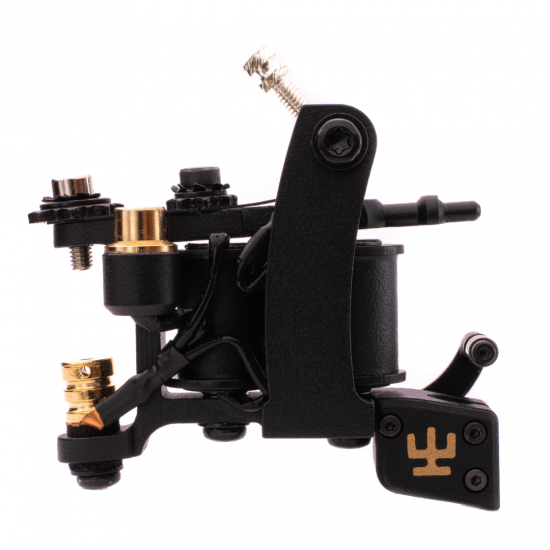
Type: coil | Weight: 198g | Voltage: 7.5–8.5V | Best For: fine, precise lines; detail work
Going detailed? Fine Liner Pro is engineered specifically for precision work. At 7.5-8.5V, it lays down crisp, clean lines with minimal blowouts. Works great with 3-9RL needles for everything from eyebrows to geometric detail work. The Fine Liner Pro is your answer when you need that surgical level of control. It's lighter than the Infinite Liner Pro but still maintains that coil machine authority. Perfect for realism, dotwork, linework that needs serious precision. The perfectly balanced frame with 9+7 wrap coils delivers exactly what you need without the weight.
3. Infinite Liner Air B
-550x550.jpg)
Type: hybrid | Weight: 160g | Voltage: 7.5–9V | Best For: fine to medium lines; speed and control
If you want the same quality as the Infinite Liner Pro but lighter in your hand, Infinite Liner Air B is your answer. Built from aerospace aluminum (160g), this hybrid machine gives you all the control without the fatigue on long sessions. Perfect at 7.5-9V for medium to large lines with that crisp, one-pass feel. The beauty of this machine is that it's genuinely versatile—you can work at 7.5V for delicate work or bump it to 9V for bold coverage. The lightweight construction means your hand stays fresh throughout the day, and it handles 7RL to 18+RL needles beautifully.
4. Avenger 2 Pro
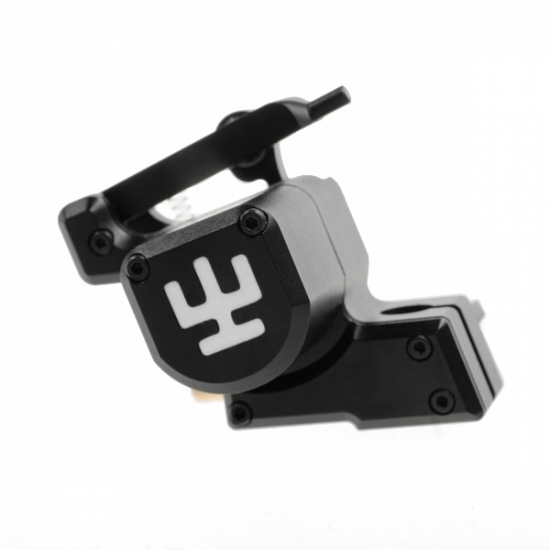
Type: hybrid | Weight: lightweight | Voltage: 7.5–9V | Best For: versatile hybrid lining; proven reliability
The predecessor to the Avenger 3 Pro, this wired hybrid machine combines the best of coil and rotary technology for versatile lining capabilities. At 135g, it delivers consistent line quality across various needle sizes at 7.5-9V. The MultiStroke system lets you switch between six stroke options (3.2mm to 5.5mm) in seconds, so one machine adapts to different line styles without swapping equipment. The hybrid action provides smooth, controlled strokes perfect for both bold lines and detailed work. If you prefer a cable-driven setup and want proven reliability with hybrid versatility, Avenger 2 Pro is an excellent choice that offers solid performance at a reasonable price point.
5. Avenger 3 Pro
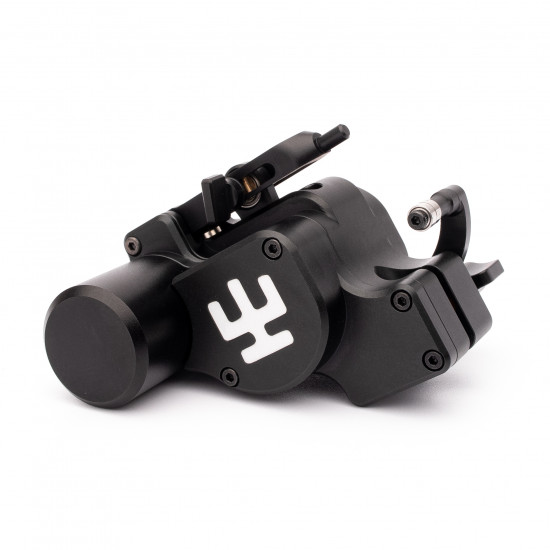
Type: hybrid | Weight: 134g | Voltage: 7.5–9V | Best For: versatile lining (modes 3.2mm–3.5mm)
The Swiss Army knife of lining. Avenger 3 Pro has six different modes, with 3.2mm (100-130 Hz) and 3.5mm (85-115 Hz) modes specifically optimized for lining. The beauty here? You can switch between modes in 7 seconds, so one machine adapts to different line styles without swapping equipment. At 134g, it's the lightest machine on this list. The DirectPower motor (12.6W with heavyweight flywheel) runs on constant 12V, with speed adjusted through motor windings. The battery lasts up to 7 hours in 4.2mm mode at 85Hz. If you want maximum versatility in a single machine, this is it.
Top shading machines from Vlad Blad
1. Blacker Packer Pro
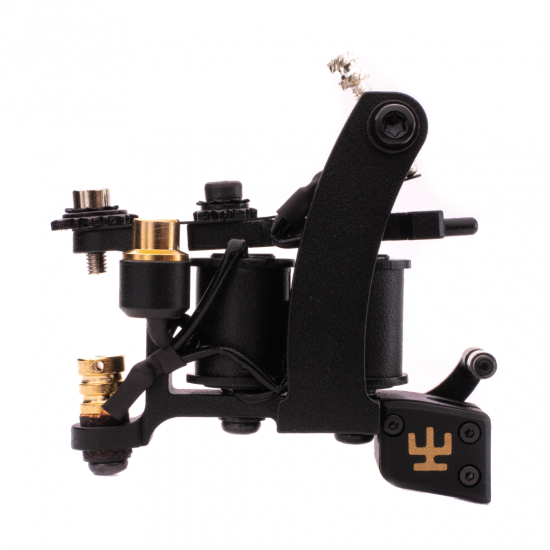
Type: coil | Weight: 212g | Voltage: 7–8.5V | Best For: black packing; solid shading; heavy work
Blacker Packer Pro is built for heavy-duty shading and blackwork. The 212g steel frame absorbs vibration beautifully, giving you smooth, controlled packing even at 7-8.5V. Works with magnums from 7M to 25M, and even up to 49M. This is the machine you want when you're filling in large areas with solid black or doing heavy color work. The coil mechanism delivers consistent, smooth needle movement that translates directly to even color saturation. The 9-wrap coils with a specially designed heavy armature bar create that perfect balance of power and control. It's built for marathon shading sessions.
2. Blacker Packer Air B
-550x550.jpg)
Type: hybrid | Weight: 167g | Voltage: 6.5–8V | Best For: medium shading; controlled packing
Want that Pro performance in a lighter package? Aerospace aluminum (167g) keeps it nimble while maintaining the smooth, controlled stroke at 6.5-8V. Perfect for artists who do lots of shading sessions and don't want hand fatigue by session's end. The Blacker Packer Air B is your middle ground—all the shading power you need without the weight. It handles color work beautifully and transitions between light and heavy shading with ease. For sessions where you're doing both lining and shading, this machine keeps your hand fresh.
3. Infinite Liner Air B
-1100x1100.jpg)
Type: hybrid | Weight: 160g | Voltage: 6.5–8V | Best For: versatile shading; color work
Yeah, it's on the lining list too—that's the point. Infinite Liner Air B is genuinely versatile. Drop it to 6.5-8V and it becomes a beautiful shading machine. The lightweight aluminum construction (160g) makes it ideal for long shading sessions where control matters more than raw power. The smooth hybrid action works great for color transitions and soft shading. This is the machine for artists who want one setup that handles both lining and shading without compromise.
4. Ultron 3
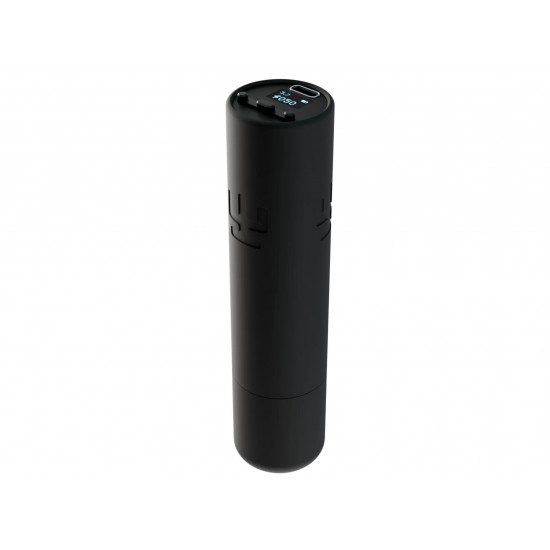
Type: rotary | Voltage: 6–7.5V | Best For: smooth shading; color packing; soft work
Pure rotary elegance for shading. At 6-7.5V, Ultron 3 delivers buttery-smooth strokes perfect for soft shading, color transitions, and artists who prioritize a delicate touch. Rotaries have a different feel than coils—if you like that smooth, even needle speed, this is your machine. The consistent, linear needle movement means minimal skin trauma and beautiful color blending. For artists trained on rotaries or transitioning from rotaries, this is the natural choice.
5. Avenger 3 Pro
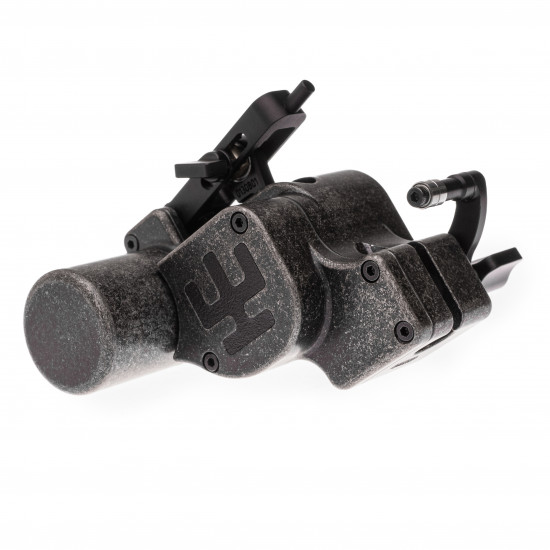
Type: hybrid | Weight: 134g | Voltage: 6–8V | Best For: versatile shading (modes 3.8mm–4.7mm)
Modes 3.8mm (80-110 Hz), 4.2mm (70-110 Hz), and 4.7mm (60-100 Hz) are specifically tuned for shading work. Run it at 6-8V depending on the technique, and the wireless flexibility means you can adjust voltage and mode mid-session without swapping machines. The MultiStroke technology lets you fine-tune how the needle moves for different effects. At 134g, it's incredibly light, and the battery flexibility (15 minutes charging = ~1.5 hours work) means you're never stuck hunting for a power outlet. If you want to do complete tattoos (lining and shading) with a single machine, Avenger 3 Pro is your answer.
Key takeaways
Here's what you need to remember:
Lining requires more voltage (7.5–9V) than shading (6–8V). This isn't arbitrary—it's physics. Lining needs needle speed and penetration; shading needs control and precision.
Not all machines are created equal. Coil machines, rotaries, and hybrids behave differently at the same voltage. Know your machine's personality, and dial accordingly.
Start conservative, then adjust. Especially if you're new. Better to add voltage than to destroy skin trying to get results at too-high settings.
Quality matters. A well-engineered machine from a trusted maker (like Vlad Blad) holds consistent voltage throughout your session. Cheap machines drift, which means your work suffers.
Your setup is personal. These voltage ranges are guidelines, not gospel. Your hand speed, needle choice, skin type, and machine all factor in. Do your testing on synthetic skin, find your sweet spot, and document it.
Vlad Blad machines come factory pre-tuned, which means they're ready to work right out of the box. Combined with 25-year warranties on coil machines and consistent quality checks, you're getting machines engineered for precision, which means voltage stability you can rely on.